
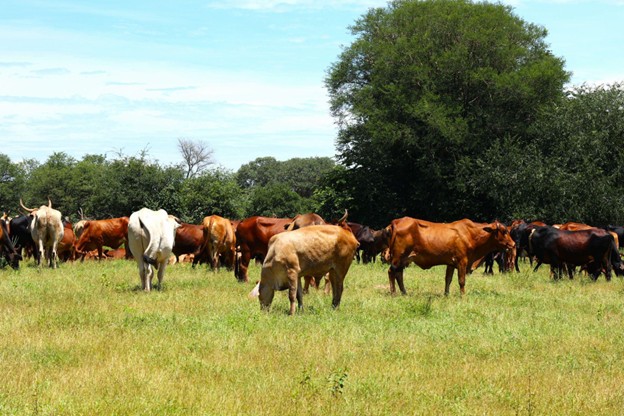
Photo: Natalia Nemutenzi/ PELUM Zimbabwe.
Oswell Phiri (39), a smallholder farmer from BH9 Ndlovu Village in Ward 3 under Chief Mvutu, has experienced significant positive change since joining Igugu Trust, a partner to PELUM Zimbabwe in 2019. As both a farmer and community herder, Oswell has adopted Holistic Land and Livestock Management practices, which have transformed his livestock production and overall livelihood.
For years, Oswell struggled to maintain the health and strength of his cattle. Despite owning a small herd, he faced constant challenges in feeding and protecting them, and his livestock were not reaching their full potential.
“Before joining the Holistic Land and Livestock Management programme, I faced significant challenges in managing and protecting my livestock, particularly from stray animal attacks during grazing. Feeding was also difficult due to poor quality grazing areas, which affected the strength and condition of my animals. As a result, I was unable to sell them at competitive prices,” he explains.
After joining the Holistic Land and Livestock Management initiative, Oswell’s livelihood has changed significantly, and he has managed to earn a living through improved livestock management.
“However, after adopting Holistic Land and Livestock Management (HLLM) practices, I have grown my herd to seven cattle, even after selling some. My livestock are now healthier, stronger, and better managed, reflecting the benefits of improved grazing and herding practices. We are also able to sell our cattle at better prices because we now market them collectively as a group rather than individually,” he says.
Through support from Igugu Trust, in partnership with PELUM Zimbabwe, Oswell has also benefited from trainings in improved cattle herding and rangeland management. These skills have enabled him to better care for his livestock while improving the surrounding environment.
“Our way of life has changed, we now have enough and healthy grass for our livestock, and the land has improved. We are also using our cattle for crop field impaction, which is improving our soil fertility. This has also reduced livestock losses and improved our income, as we can now sell healthy livestock at fair prices. We are now more confident in our farming because we see the results of what we are doing,” he shares.
The efforts being implemented by Igugu Trust are also being felt at community level, according to Albert Ndlovu (49), a Village Head from Kachechete Village in Ward 3. Highlights that the initiative is delivering broader benefits beyond individual households, strengthening livestock management practices and supporting improved grazing systems within the community.
“Since the introduction of the Holistic Land and Livestock Management programme, our village has changed for the better. People are coming together to protect their livestock from diseases and stray animals, manage grazing areas, and share practical knowledge. I have seen neighbours supporting each other, solving challenges together, and taking pride in their livestock. This programme has not only improved the health of our animals but has also brought our community closer, creating a stronger, more united village,” he says.
Elijah Nyathi (70), a village herder from Ndlovu Village, highlights the inclusive and collective approach of the programme, noting how it brings community members together to improve livestock management and strengthen sustainable grazing practices.
“The work being done by Igugu Trust has brought our community together. Many households are now involved in the project, and people are taking up leadership roles. As a community, we are now saving together and supporting one another, which has strengthened our unity. When challenges arise, especially concerning livestock, we work together to respond and find solutions,” he explains.
Overall, the initiative has not only improved livestock productivity and environmental management but has also strengthened social cohesion, community leadership, and resilience in Hwange.


