
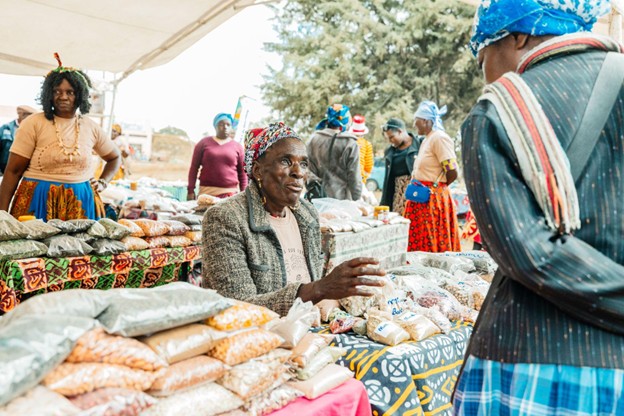
Lucia Sora is a passionate smallholder farmer from Fambidzanai Permaculture Centre (FPC). Lucia joined Fambidzanai Permaculture Center in 2023 after developing a keen interest in ecological farming and sustainable food production. Before joining the organization, she mainly relied on synthetic fertilizers and chemicals to grow her crops. Like many farmers in her community, she believed that chemical inputs were the only way to achieve good harvests and improve productivity. However, the high costs of fertilizers and chemicals, coupled with changing climatic conditions, made farming increasingly difficult and unsustainable for her household.
“Before I joined Fambidzanai Permaculture, I used to grow my crops using synthetic fertilizers and chemicals because I thought that was the only way to achieve better yields. I did not have knowledge on organic farming or how to prepare organic fertilizers for my crops. Farming had become expensive because every season I had to look for money to buy synthetic fertilizers and chemicals. Sometimes the crops would still perform poorly because of droughts and unpredictable weather patterns,” she explains.
After joining Fambidzanai Permaculture Centre, Lucia received training on organic farming, soil conservation, seed preservation, compost making, and the importance of traditional grains in building climate resilience and improving household nutrition. Through these trainings and learning exchange visits with other farmers, her understanding of sustainable agriculture changed completely.
“After joining the organization, my way of farming completely changed. I shifted from depending on synthetic fertilizers and started producing organic fertilizers using locally available and affordable materials such as animal manure, leaves, and household waste. I also learned natural ways of controlling pests without using harmful chemicals. This knowledge helped me reduce farming costs while improving the quality of my produce and protecting the soil,” she says.
Lucia also emphasized that organic farming has not only improved her harvests but has also changed the way her family consumes food. Her household now enjoys healthier meals made from traditional grains and organically grown vegetables. She believes traditional foods are highly nutritious and play an important role in preserving cultural identity and improving community health.
“Now people at my house appreciate traditional foods because they help us stay healthy and strong, even doctors have encouraged us to eat traditional foods. Our traditional foods are healthy and nutritious. Crops like rapoko, sorghum, and millet are important because they are drought resistant and good for our bodies. We grew up eating these foods, but along the way many people abandoned them,” she says.
Through her hard work and determination, Lucia has managed to establish a small shop where she sells organic produce harvested from her fields. The shop has become a source of income and has helped improve her family’s livelihood. She now earns money from selling traditional grains, vegetables, nuts, and other organic products to people within and outside her community.
“I have managed to open a shop where I sell organic produce from my field, and through this work I now earn a steady income for my family. The demand for organic traditional foods is growing because many people now understand the importance of healthy eating. Through the income I get, I am able to support my household needs and reinvest into my farming activities,” she explains.
Participating in the Good Seed and Food Festivals has also contributed significantly to the growth of her farming business and confidence as a farmer. The festivals have provided her with opportunities to market her produce, exchange ideas with other farmers, and learn more about indigenous seeds and sustainable farming practices.
“Every year I attend the Good Seed and Food Festival with my products, and I always make good sales. The festivals have helped me grow my business and increase my profits because many people appreciate organic traditional foods. I also learn a lot from interacting with other farmers and organizations during these events and have also managed to exchange seeds and knowledge with other farmers.These learning platforms continuously motivate me to work harder and encourage others in my community,” she says.
Martha Ndlovu (45), a fellow farmer from Mwanza Ward 12, speaks about the impact organic farming and traditional foods are having in the community and how Lucia has also become a source of inspiration and knowledge in her community. Through demonstration plots, community meetings, and farmer to farmer learning sessions, she has managed to train and influence many women and farmers to embrace organic farming and traditional food production. Many women are now growing their own food using affordable local resources instead of relying heavily on expensive chemical inputs.
“Through the work being done in our community, many families are now returning to traditional foods and organic farming practices. Lucia has played a very crucial role in the community advocating for traditional ways of farming. She has managed to train many women in the community on how to grow traditional foods and practice organic farming. Most women are now seeing that they can produce healthy food without spending too much money. This knowledge is empowering women because they are now able to feed their families, earn income, and improve their livelihoods using resources they already have,” she shares.
Evidence Kugarisana (35), a youth farmer from Mwanza Goromonzi District, says traditional and organic farming practices are proving to be powerful pathways towards sustainable livelihoods, economic empowerment, and community resilience.
“Traditional ways of farming are showing us that agriculture can become a strong and reliable source of income while preserving our culture and protecting the environment. Through growing and selling traditional grains, organic vegetables, and indigenous produce, farmers are now able to earn meaningful incomes without depending heavily on expensive chemical inputs. Lucia’s success is inspiring many young people in our community to see farming differently, not as a struggle, but as a business opportunity that can transform lives. Her work is proving that traditional foods and ecological farming practices have the power to create employment, improve household incomes, and empower youths to become self-reliant while preserving our indigenous knowledge systems for future generations,” he says.


