
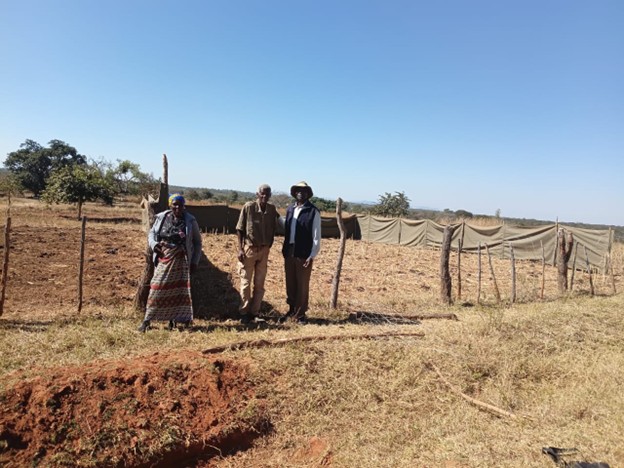
Munyika Pachawo (52), a smallholder farmer from Ward 5 in Shurugwi District, is witnessing remarkable changes in both his grazing lands and crop fields through the adoption of Holistic Land and Livestock Management (HLLM) practices. Working with Njeremoto Biodiversity Institute (NBI), a member of Participatory Ecological Land Use Management (PELUM) Zimbabwe, Munyika says the programme has transformed areas that were once degraded into productive landscapes that support both livestock and crop production.
Like many farmers in Shurugwi District, Munyika depends on livestock and crop production to support his household. However, years of poor grazing management had contributed to the deterioration of grazing lands, leaving many areas with little vegetation and limited pasture for livestock.
Before adopting HLLM practices, Munyika says farmers in his community were struggling to sustain their livestock due to declining pasture availability.
“Before we started practising Holistic Land and Livestock Management, many parts of our grazing areas were bare and there was very little grass for our livestock. During the dry season, it became difficult to find enough pasture for our cattle and the condition of the land continued to worsen. We were concerned because our livestock depended on these grazing areas, yet every year the land seemed to be losing its productivity,”he says.
The deteriorating condition of the rangelands affected livestock production and increased pressure on farmers who relied on cattle for their livelihoods. Community members recognised the need for a different approach to managing their natural resources.
Through NBI, farmers were introduced to Holistic Land and Livestock Management, including planned grazing and the use of boma sheets. These practices use livestock as a tool for landscape restoration by concentrating cattle in specific areas and managing their movement across grazing lands.
As farmers began implementing the practices, positive changes started becoming visible across the landscape.
“After adopting HLLM, we started using boma sheets and practising planned grazing. As cattle moved through the grazing lands, they trampled the soil, deposited manure and urine, and helped improve the condition of the land. At first, some of us were not sure how effective the practice would be, but as time went on, we began seeing the land responding positively. Areas that had remained bare for years slowly started recovering,” says Munyika.
For Munyika and other farmers in Shurugwi, Holistic Land and Livestock Management has become more than a farming practice. It is a pathway towards restoring degraded landscapes, improving productivity and building resilience within their communities.
“The changes we are seeing are encouraging. Where there was once bare land, there is now grass. Where our fields were less productive, we are now harvesting more. HLLM has shown us that by managing our livestock and land properly, we can restore our environment, strengthen our livelihoods and create a better future for our communities,” he says.
The restoration of grazing lands has improved ground cover and pasture availability while contributing to healthier ecosystems. Farmers are increasingly witnessing the return of vegetation in areas that had previously shown signs of degradation.
“We are now seeing grass growing in places where there was no grass before. Areas that used to be bare are now covered with vegetation, and our grazing lands have improved significantly. The land looks healthier, and livestock have access to more grazing than before. What excites us most is seeing nature recover. Places that were once exposed and degraded are now supporting different types of grasses and vegetation,” Munyika explains.
Beyond restoring grazing lands, community members have also applied HLLM principles in their crop fields through crop field impaction. The practice involves kraaling cattle in crop fields before planting, allowing livestock manure, urine and animal impact to improve soil fertility and moisture retention.
According to Munyika, the difference between impacted and non-impacted fields became evident during the cropping season.
“We used cattle to impact some of our fields before planting maize. The cattle deposited manure and urine while their movement helped break the soil surface. When we planted, we could clearly see the difference between the impacted field and the field that had not been impacted. The maize on the impacted land performed much better. The crop was healthier, stronger and greener, and the harvest was significantly higher. It showed us the value of using livestock as a resource for improving our soils,” he says.
The improvements in crop performance have strengthened farmers’ confidence in sustainable land management practices while reducing dependence on costly external inputs.
“The manure and animal action improved the quality of our soil. The land is now more productive, and we are getting better harvests than before. Through these practices, we are learning that healthy soils are the foundation of productive farming systems,” adds Munyika.
Josaya Mutizira (60), a Field Officer with Njeremoto Biodiversity Institute, says the changes being witnessed by farmers demonstrate the effectiveness of Holistic Land and Livestock Management in restoring degraded landscapes while improving agricultural productivity.
“We are seeing improved ground cover, increased pasture availability and healthier soils in communities adopting HLLM practices. Farmers are using livestock as a tool for restoring grazing lands and improving crop production through crop field impaction. The positive changes being witnessed show that communities can restore their natural resources while improving their livelihoods,” he says.
Osmond Mugweni (PhD) (70) the Coordinator for Njeremoto Biodiversity Institute working with the community, says the programme is helping farmers strengthen their resilience to climate-related challenges.
“The restoration of grazing lands and improvement of soil fertility are strengthening the capacity of farmers to cope with climate change. These practices are helping communities build more sustainable farming systems that improve productivity while protecting the environment. When farmers manage their natural resources sustainably, they are better positioned to secure their livelihoods for future generations,” she explains.
For Munyika and other farmers in Shurugwi, Holistic Land and Livestock Management has become more than a farming practice. It is a pathway towards restoring degraded landscapes, improving productivity and building resilience within their communities.


