
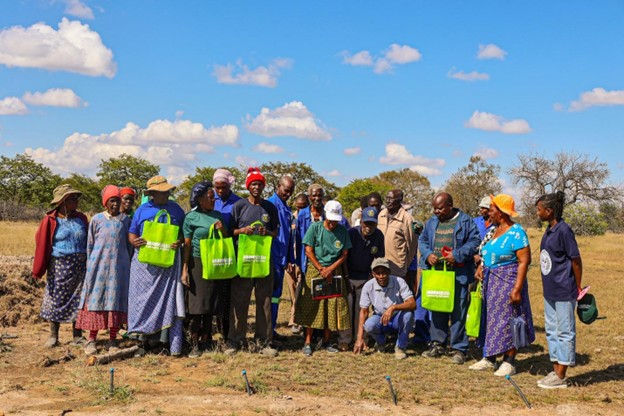
Smallholder farmers working under the Abavuseleli Project in Matobo District are restoring degraded landscapes, improving soil fertility and strengthening food security through the adoption of Holistic Land and Livestock Management (HLLM) practices. Among them is Paulinos Ndlovu, a smallholder farmer from Hlababonvu in Sibanjane village, who is witnessing significant changes in both his crop fields and grazing lands.
The initiative is supporting communities in Matobo to build resilience to climate change through sustainable land management practices that integrate livestock and crop production.
A passionate farmer, Paulinos Ndlovu (73) grows small grains such as sorghum, millet and rapoko while also rearing livestock. Like many farmers in Matobo District, he relies on both crop and livestock production to support his household’s food security and income. Felix joined Abavuseleli Bemvelo in 2024 which is a Participatory Ecological Land Use Management (PELUM) Zimbabwe member organization.
Before joining the project in 2024, Paulinos shared that farming was becoming increasingly difficult due to low and erratic rainfall. Matobo district falls under Natural Farming Regions 4 and 5 which are characterised by low and erratic annual rainfall and frequent dry spells which results in declining soil fertility and deteriorating grazing lands that affect both crop and livestock production.
“Before joining the project in 2024, our biggest challenge was water. Matobo is a dry area and we receive very little rainfall. Because of the poor rains, our crops often failed and yields were very low. The soils were also becoming less productive, making it difficult for us to harvest enough food for our families. The situation was also affecting our grazing lands, as many areas had very little grass for livestock. As farmers, we were worried about the future because both our crops and livestock depended on natural resources that were becoming increasingly degraded,” he says.
Through trainings organised under the Abavuseleli Project, Paulinos was introduced to Holistic Land and Livestock Management practices such as planned grazing and crop field impaction. The approaches provided practical solutions for improving soil fertility, restoring degraded grazing lands and strengthening the community’s ability to cope with climate-related challenges.
Crop field impaction involves kraaling livestock in crop fields for a specified period, allowing manure, urine and animal impact to improve soil fertility and water retention over time. Combined with planned grazing, the practice is helping communities restore ecosystem health while improving agricultural productivity.
“Through the project, I learned how crop field impaction can improve soil fertility naturally using resources that are already available within our communities. We started using livestock to impact our fields, and over time I noticed that the soil was becoming healthier and able to retain moisture for longer periods. This has helped improve crop growth even during seasons when rainfall is low. The practice has shown us that we can restore our soils without relying heavily on expensive inputs, while also improving productivity in our fields,” says Paulinos.
As he began implementing the practices, noticeable improvements started emerging in both his crop fields and grazing areas. Livestock manure, urine and animal impact contributed to healthier soils, while coordinated grazing management supported the regeneration of vegetation across the landscape.
“Since adopting these practices, our land has changed significantly. Areas that previously had very little grass are now covered with vegetation. We have seen the return of many different grass species and today we can identify more than 20 types of grasses in our grazing areas. The land is recovering and our livestock now have better grazing than before. These changes have also helped protect the soil from erosion, improve water infiltration and strengthen the condition of our rangelands,” he says.
The positive changes have also extended to crop production. Through crop field impaction, farmers are improving soil fertility and moisture retention, resulting in healthier crops and better harvests despite the district’s challenging climatic conditions.
“Crop field impaction has improved the condition of my soil and helped it retain moisture for longer periods. Even in our dry environment, I began to see improvements in crop performance and yields. My fields are now more productive than before. Small grains such as sorghum, millet and rapoko are performing much better, and I am harvesting more than I used to. The improvements in soil fertility have helped me become more confident in farming despite the challenges associated with climate change,” Paulinos explains.
Beyond improvements in crop and livestock production, the programme has strengthened relationships among community members. Through collective grazing management and crop field impaction activities, farmers are working together more closely, sharing knowledge and supporting one another in restoring their natural resources.
“One of the biggest changes we have seen is how the HLLM programme has brought people together. Through crop field impaction and collective herding practices, community members are working together more than before. These activities have strengthened collective action in managing both croplands and grazing areas, reinforcing the principles of holistic land and livestock management. The programme has strengthened relationships among neighbours and created a sense of unity within our village. Today, people are more willing to work together and support each other for the benefit of the whole community”, says Paulinos.
A fellow farmer from the community, Jennifer Moyo (54) shares that the adoption of HLLM practices is transforming both livelihoods and the environment in Matobo.
“The changes are visible across our community. Areas that were once bare are now covered with different grass species, creating better grazing conditions for livestock. Farmers are also reporting improvements in soil fertility and crop productivity as a result of crop field impaction. Beyond the environmental benefits, the programme has encouraged collaboration among community members, making it easier for farmers to learn from one another and work towards common goals. We are seeing communities becoming more resilient and more confident in their ability to respond to climate related challenges,” says Jennifer.
The Director for the Abavuseleli Project, Dingaani Ndlovu (61), says the changes being experienced by farmers demonstrate the potential of community driven approaches to restore ecosystems and strengthen livelihoods in drought-prone areas.
“The results we are seeing in Matobo demonstrate the potential of Holistic Land and Livestock Management in restoring degraded landscapes while improving livelihoods. Farmers are reporting improved soil fertility, better moisture retention and increased vegetation cover in their grazing areas. The return of diverse grass species is a strong indicator that ecosystem health is improving. At the same time, communities are becoming more organised and working together to manage natural resources sustainably, which is critical for building resilience in dry regions such as Matobo. These are the kinds of locally driven solutions that contribute to long-term food security and environmental restoration,” says Dingaani.
Paulinos continues to champion Holistic Land and Livestock Management practices within his community and encourages other farmers to embrace sustainable approaches that improve both productivity and environmental health.


