
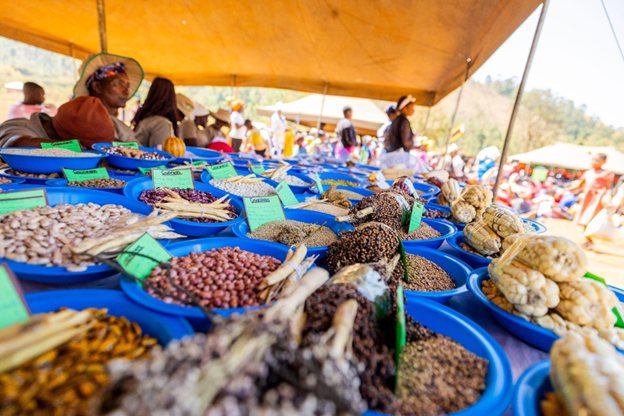
In Fungai Village, Gutu District, Regina Pabiwa (65) is showing how women farmers can transform livelihoods and preserve indigenous seeds through agroecology.
Working with Chinyika Community Development Trust (CCDT), a member of Participatory Ecological Land Use Management (PELUM) Zimbabwe, Regina has become a dedicated smallholder farmer specializing in traditional crops such as sorghum, finger millet, cowpeas, pumpkin seeds, and groundnuts.
Her success has not only improved her family’s wellbeing but also revived the value of traditional crops in her community.
Regina recalls the challenges she faced before joining CCDT. She says these days were full of uncertainty and laden with daily challenges.
“Before I joined Chinyika I struggled to earn enough money to support my family. I relied only on local markets, which limited my sales and often left me with unsold produce. This created financial stress and made it hard to pay for essentials like school fees and medical expenses,” she says.
Determined to improve her livelihood, Regina embraced the training and support offered by CCDT. She learned sustainable farming practices and effective marketing strategies, which encouraged her to focus on producing traditional seeds suited to the changing climate.
“I attended several trainings organized by CCDT that opened my eyes to new market opportunities. Before that, I was only selling within my local community. Through the trainings, I got a chance to sell beyond my village and even started exporting some of my traditional crops to South Africa. For the first time, I was able to earn enough money to support my family, pay school fees, and meet household needs. It gave me confidence because I realized traditional crops like sorghum, finger millet, and bambara nuts (nyimo) are not only good for food security but can also bring good income,” she shares.
Today, Regina earns a steady livelihood through farming and selling traditional seeds.
“Through farming and selling traditional grains, I am now able to support my family and take care of my grandchildren. I have become an independent woman because of selling traditional seeds,” she says proudly.
Her work extends beyond her household. Regina participates in seed fairs and workshops, encouraging other farmers to embrace traditional crops.
“I have attended workshops in our community encouraging others to grow traditional grains and showing them how they can also earn a living by selling traditional seeds. I believe that by working together, we can preserve our cultural heritage while achieving financial stability and resilience against climate change,” she explains.
Her efforts are widely recognized. Fellow farmer Victor Mazorodze (30) highlights the broader impact of the work being done by Regina and other women.
“We are witnessing a positive change among farmers practicing agroecology. Many smallholders are now earning meaningful incomes by growing and selling traditional grains. By valuing indigenous crops and using sustainable methods, farmers are improving food security and accessing better markets. This has strengthened livelihoods and given farmers confidence that agriculture can provide a reliable source of income while protecting our environment and preserving traditional knowledge,” he says.
Nomatter Mabhawu (28), Projects Officer at Chinyika Trust, underscores Regina’s influence in promoting sustainable development within the community.
“Regina is an inspiration in our community. Her dedication to selling traditional grains empowers others to embrace sustainable farming practices. This shift is crucial in tackling food insecurity while preserving our agricultural heritage. Regina has not only secured her family’s future but also inspired a movement among local farmers to value and invest in their traditions,” she shares.
Through her commitment to agroecology and seed preservation, Regina Pabiwa has become a beacon of resilience in Gutu District, proving that traditional seeds can secure livelihoods, strengthen communities, and safeguard cultural heritage for generations to come.


