
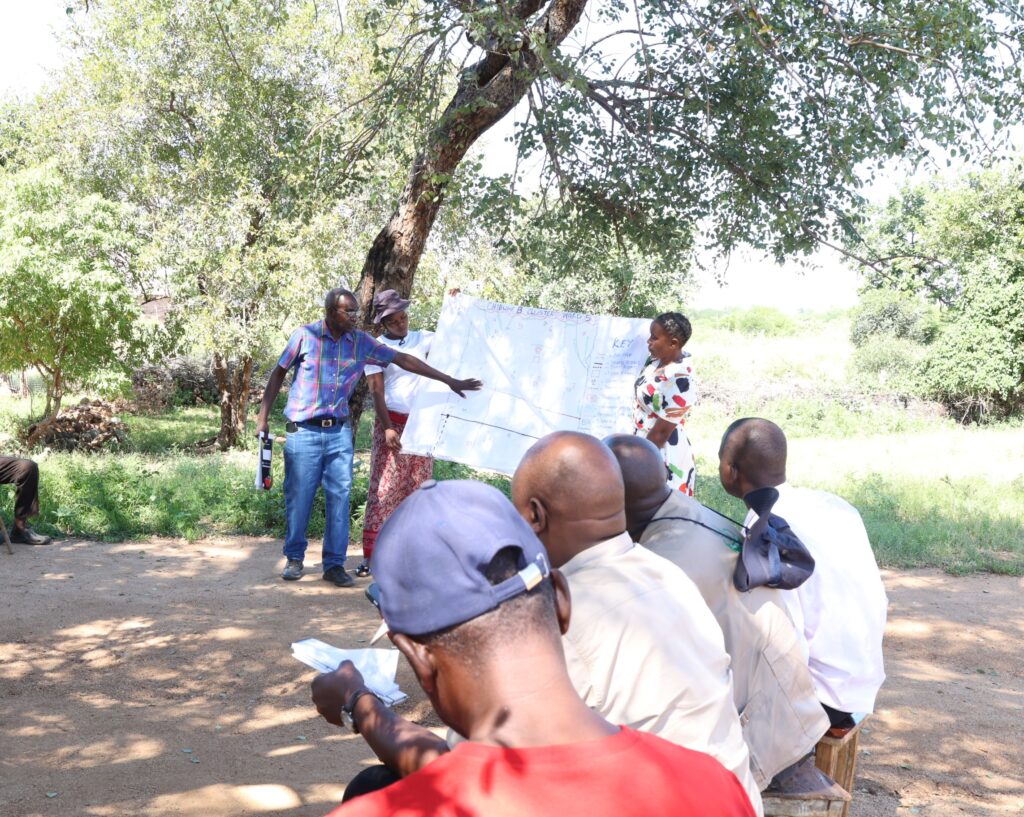
In Chimanimani District, Hot Springs Ward 5 (Chibuwe B), 68-year-old Joshua Maringe is actively involved in spreading and advocating for the Holistic Land and Livestock Management (HLLM) programme within his community. He serves as the Chairperson of the Hot Springs Chibuwe B (HLLM) Committee and works with the Towards Sustainable Use of Resources Organisation (TSURO) Trust, a Participatory Ecological Land Use Management (PELUM) Zimbabwe partner, where he promotes sustainable farming practices. He is also engaged in the cultivation of traditional grains such as sorghum, millet, and rapoko.
Joshua has been farming for many years using synthetic fertilisers, but his approach has significantly changed since joining TSURO Trust and adopting (HLLM) practices. He has also embraced crop field impaction using cattle, which has improved soil fertility and crop productivity on his land.
“Before I joined TSURO Trust, I relied on synthetic fertilizers to boost my crop production. I would buy fertilizers from the shops for boosting my crops and mainly focused on growing maize. However, after joining the programme, our way of living has changed. We now grow different types of traditional grains such as sorghum, millet, and rapoko. We now produce a diverse range of crops and are able to feed our families throughout the year from our own fields,” he says.
Crop field impaction using cattle is transforming soil fertility and boosting crop productivity within Joshua’s community. Since adopting this practice, farmers have recorded significantly higher harvests than before. The approach is implemented collectively, with members taking turns to carry out crop field impaction on each other’s fields, rotating cattle across all plots to ensure everyone benefits while strengthening community cooperation.
“We are also practicing crop field impaction, where we keep cattle in one area using boma sheets for about two weeks. During this time, the cattle feed and stay in the field, depositing manure, and after two weeks we move them to another farmer’s field. We do this collectively for each and every member of the committee so that everyone benefits. Since we started this practice, we have achieved rich bumper harvests, and even when we continue using the same fields, the soil remains fertile,” he says.
Joshua also highlights how the programme has strengthened collective action within the community. As a committee chairperson, Joshua has played a key role in guiding the implementation of HLLM practices in his area, supporting knowledge sharing and encouraging community and youth participation.
“We started as a small group of herders, but now our numbers have increased, including men, women, and youth. The youth are now actively involved and benefiting from the programme he says. Through TSURO Trust, we also received improved breed bulls, which have helped us to increase our herd size and improve the quality of our cattle,” he says.
Thulani Maphosa (33), Project Officer from TSURO Trust, says his organisation has been working with farmers like Joshua in promoting sustainable agriculture and his story demonstrates how agroecology and holistic land and livestock management practices can transform livelihoods, improve soil fertility, and strengthen community resilience in Chimanimani.
“Joshua’s progress is a clear demonstration of how Holistic Land and Livestock Management can transform both livelihoods and landscapes. Through farmer-led approaches such as crop field impaction and collective action, communities are improving soil fertility, increasing productivity, and strengthening food security. What is particularly encouraging is the level of community ownership and participation, which is key to the sustainability of these interventions,” he says.
The Veterinary Services Officer, Julian Makuwa (42), from Chimanimani, shares her perspective on the implementation of the Holistic Land and Livestock Management (HLLM) programme by TSURO Trust and its impact on animal health in the district. She highlights that the programme has played a key role in improving livestock management practices, leading to healthier animals, reduced disease outbreaks, and better overall herd performance.
“The Holistic Land and Livestock Management programme has supported the adoption of structured grazing and improved livestock management practices, which have significantly enhanced animal health in the area. We are seeing stronger, healthier cattle, reduced disease risks, and better overall herd management. These practices not only improve livestock productivity but also contribute to sustainable land use and long-term resilience for farming communities,” she said.


