
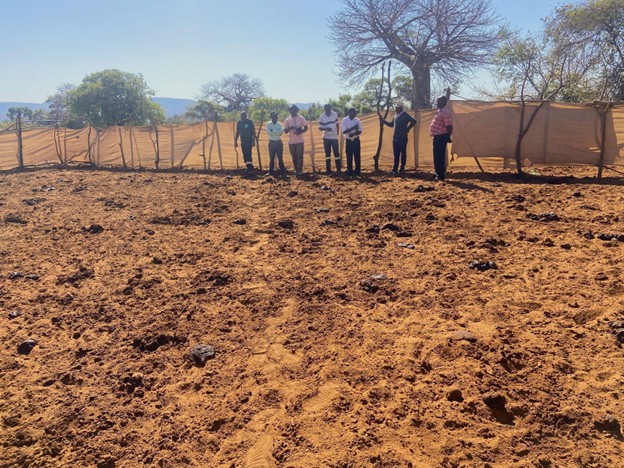
Nomatter Matuta (31), a young farmer from Chibuwe B Cluster, is proving that young people can play a leading role in promoting sustainable agriculture and community development. Working with Towards Sustainable Use of Resources Organisation (TSURO) Trust, a partner of Participatory Ecological Land Use Management (PELUM) Zimbabwe, under the Holistic Land and Livestock Management (HLLM) programme, Nomatter has become a passionate advocate for sustainable land management practices and is actively sharing knowledge with fellow community members.
As a young woman with a keen interest in farming, Nomatter has embraced Holistic Land and Livestock Management and is helping to demonstrate how livestock can be used to restore landscapes, improve soil fertility, and strengthen community resilience in Chibuwe B Cluster. Through her involvement in the programme, she has become a role model for other young people and an active participant in community-led land restoration efforts.
Before becoming involved in the HLLM programme, Nomatter had limited knowledge about holistic land management practices. Although she participated in farming activities, she did not fully understand the role livestock could play in improving soil health and restoring degraded land.
“Before joining the programme, I knew very little about Holistic Land and Livestock Management. I was interested in farming, but I did not understand how crop field impaction and the use of boma sheets could improve our soils and increase production. Like many young people in rural communities, I only viewed farming as an important source of livelihood but had few opportunities to access specialised knowledge on sustainable agricultural practices,” she says.
“After I joined TSURO Trust, things began to change. I became involved in HLLM activities being implemented by TSURO Trust. Through trainings, practical demonstrations, and farmer learning platforms, I started gaining knowledge on sustainable land management and the integration of livestock and crop production,” she says.
Her passion for learning eventually earned her an opportunity to participate in a learning exchange visit where she interacted with farmers from other communities who were successfully implementing HLLM practices.
Nomatter recently attended an exchange visit in Insiza and Shangani Rangelands. The exchange visit became a turning point in her journey. It exposed her to practical examples of crop field impaction, planned grazing, and the use of boma sheets to restore degraded land and improve agricultural productivity.
“The exchange visit opened my eyes to the possibilities of HLLM. I saw how communities were using livestock to improve their grazing lands and crop fields. We got to learn and exchange ideas with other farmers from different areas in Zimbabwe, and I was motivated to come back and share that knowledge with other people in my community,” she explains.
Beyond improving farming practices, the programme has played an important role in strengthening relationships within the community. Through collective activities such as crop field impaction and coordinated livestock management, community members are working together more closely than before.
“In Chibuwe B, the HLLM programme has brought our community together. Farmers now work together during field activities and trainings, share ideas, and support one another. The programme has helped strengthen relationships among community members and created a sense of unity and shared responsibility,” she says.
According to Nomatter, the spirit of cooperation created through the programme has made it easier for community members to learn from one another and collectively address challenges affecting agriculture and natural resource management.
The Chairperson of the Holistic Land and Livestock Management group in Chibuwe B, Mr Maringe (69) shares that young people such as Nomatter are critical to the success and sustainability of HLLM initiatives in our community.
“It is inspiring to see young farmers taking leadership roles in promoting sustainable land management practices.Nomatter has shown great commitment to learning and sharing knowledge with others. Her involvement demonstrates the important role that youth can play in driving positive change within our community,” says Joshua Maringe.
The Project Officer from TSURO Trust, Thulani Maphosa (33), comments on how youth participation is essential for building resilient farming communities and ensuring the long-term success of sustainable agriculture initiatives.
“When young people become actively involved in programmes such as HLLM, they become ambassadors of change. They help spread knowledge, encourage innovation, and strengthen community resilience. Nomatter’s passion for the HLLM programme is a powerful example of how youth can contribute to sustainable development while inspiring others to take action,” he says.
Nomatter continues to champion Holistic Land and Livestock Management in Chibuwe B. Through her passion for agroecology, commitment to learning, and willingness to share knowledge, she is helping to build a future where young people play an active role in restoring landscapes, improving livelihoods, and strengthening communities.


